
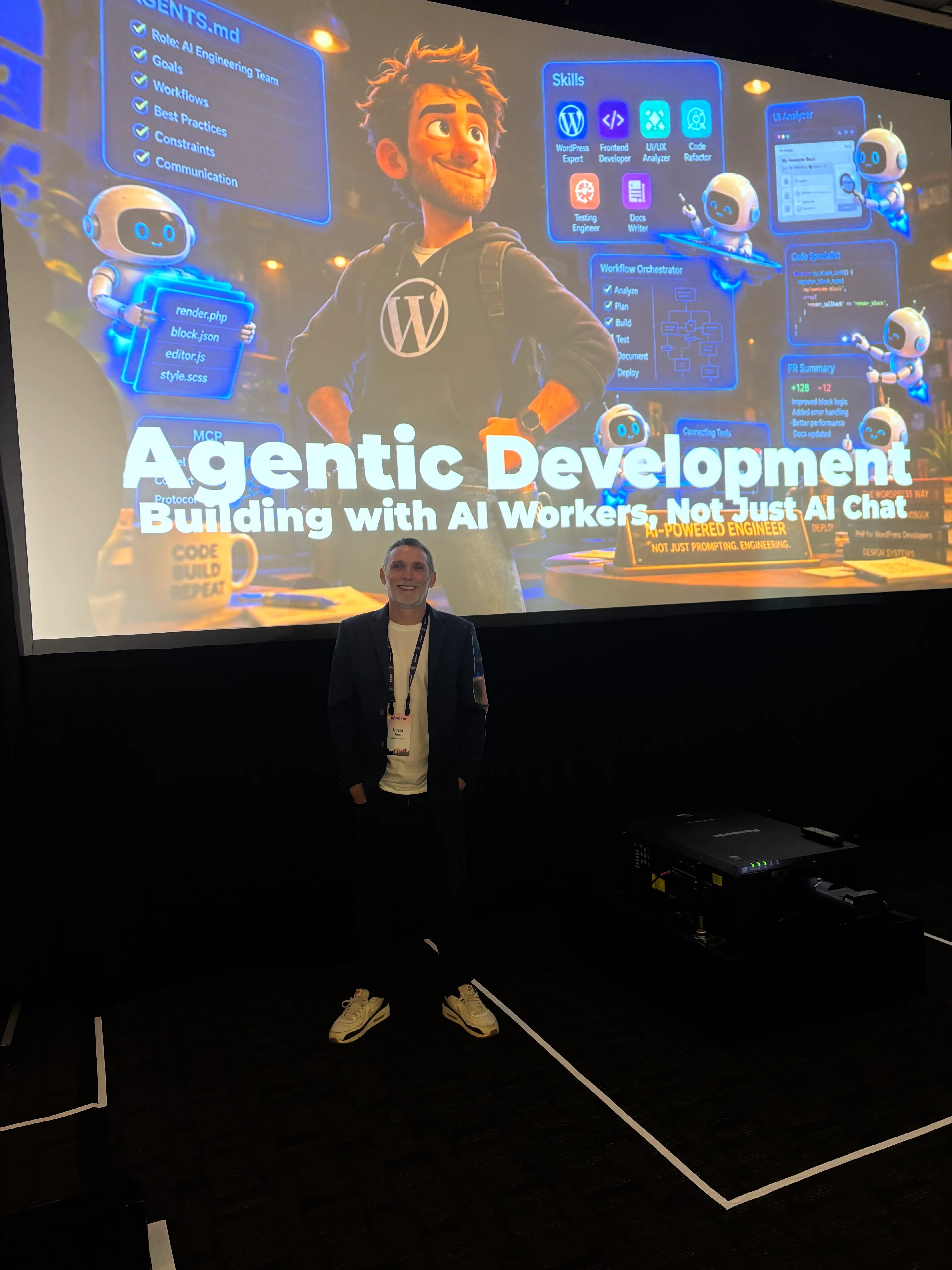
Traveling from Costa Rica to Phoenix to speak at WordCamp US 2026 was about much more than giving a talk about AI and WordPress.
It was my first time speaking at WordCamp US, and also my first time presenting there in English. I had applied to speak several times in previous years and had never been selected. So when the opportunity finally came, it meant a lot to me.
Professionally, it was a chance to gain more visibility outside Costa Rica and share what I’ve been working on with a much broader community. But there was also a sense of representation. I wasn’t traveling only as Alfredo, the developer. In some way, I was also representing the WordPress community in Costa Rica.
And yes, that added a little more pressure.
Speaking about something that is changing as we speak
My talk was “Agentic Development for WordPress – How Modern Teams Are Building with AI Workers, Not Just AI Chat.”
Agentic development is moving incredibly fast. What we are doing today will probably look different in a few months, and many of the ideas we are discussing in 2026 weren’t even part of our workflows a couple of years ago.
That made preparing the talk interesting, but it also fed a feeling I know pretty well: impostor syndrome.
Even when you know the subject, study it, and use it in your actual work, that voice still shows up asking questions.
What if I’m wrong about something?
What if someone in the audience knows much more than I do and challenges what I’m saying?
Is what I’m explaining actually important enough for these people?
There was another doubt in my case. Agentic development has become a common topic this year. Part of me assumed that many of the people sitting in that room might already know most of this.
Right before going on stage, I still had the feeling that maybe the presentation was missing something.
When the explanation became real
My session was on Wednesday, August 19, from 10:30 to 11:15, on the Technical WordPress track.
There was one moment that completely changed how I felt about the presentation.
During the talk, I showed a video of an agentic workflow running from beginning to end while I explained what was happening.
And I could see the reaction.
It was one of those “wow” moments.
I think it worked because it was no longer just me standing in front of an audience talking about agents, prompts, or workflows. People could actually watch the entire process happening in front of them, step by step, exactly as I had described it.
The idea stopped being theory.
It was working.
For me, that was probably the most memorable part of the entire talk.
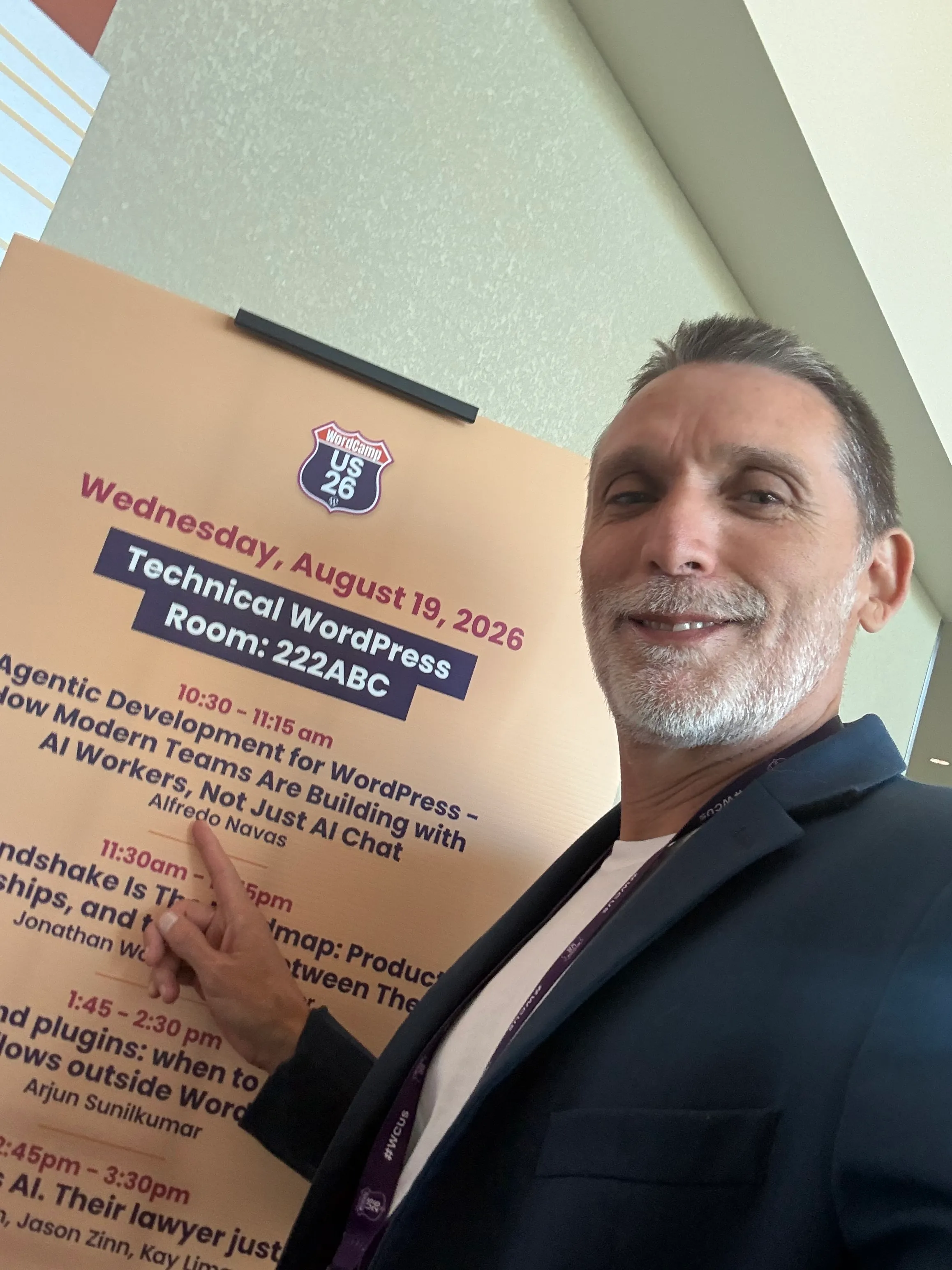
Seeing My Name on the Schedule
Seeing my name on the WordCamp US schedule filled me with pride.
Maybe not everyone already knew this
Then something happened that answered many of the doubts I had before walking onto the stage.
People started asking questions.
During the session and afterward, several people came up to talk about what they had just seen. I also met developers who were already experimenting with similar forms of agentic development.
That confirmed two things for me.
Yes, there are already people building with these workflows.
But there are also many developers who are just beginning to discover what working this way can actually look like.
Maybe the best confirmation came after WordCamp.
One of the developers I met tried the method I had presented and later sent me a message:
“Today I built this site for my boss in two hours using your prompt loop, and he couldn’t believe it.”
That message meant a lot.
Before the talk, I had been wondering whether what I was going to share would be useful enough. Not long afterward, someone had taken one of those ideas, applied it to a real project, and gotten a result that even surprised his boss.
Sometimes we need moments like that to put our own doubts into perspective.
Breaking a mental barrier
I think WordCamp US also broke a mental barrier for me.
After so many years working with WordPress, I still deal with impostor syndrome. It will probably never disappear completely.
But this experience reminded me that we have a lot to contribute.
And when I say “we,” I’m not talking only about myself.
I’m also thinking about the talent we have in Costa Rica.
Coming from a small country doesn’t mean being outside the important conversations happening in technology. We are building, experimenting, and solving many of the same problems.
We also have experiences, methods, and ideas worth sharing.
Being able to bring a small part of that to a stage like WordCamp US was important to me.
WordCamp is still about people
Phoenix also taught me something much simpler.
First: it is ridiculously hot.
People warned me many times before the trip. I knew it was going to be hot. I still wasn’t prepared for that kind of heat.
But aside from that, I came back to Costa Rica genuinely happy about the entire experience.
The talk was important, obviously. But when I think about WordCamp US, I also think about all the people I talked to, the connections I made, and the new people I got to know.
Because in the end, that is still what WordCamp is about.
We can talk about WordPress, artificial intelligence, agents, architecture, or whatever new technology comes next.
But we still come together for the same reasons: to meet people, share knowledge, and learn from each other.
I traveled to Phoenix with some doubts about whether what I had to say was important enough.
I came back to Costa Rica thinking something very different.
We have a lot to share.
We just have to be willing to share it.
Continue exploring
If you would like to explore more of this experience: